
AI is no longer an IT issue.
It is a board-level responsibility.
It reshapes how value is created, how risk is governed, and how accountability is assigned.
Board members are expected not only to contain AI-related risk, but to guide their organizations toward the opportunities AI creates — new sources of value, faster decisions, stronger competitive positions.
At the same time, investments must remain disciplined, governance must be real, and accountability must stay clear as systems scale.
In many organizations, strategy discussions, compliance efforts, and execution realities move in parallel — but not in alignment.
The result is a familiar tension: ambition increases, but clarity does not.
Segmentis AI Framework for Boards
Segmentis helps boards and senior management address these challenges through its proprietary AI Framework for Boards. The framework draws on board-level advisory work across regulated industries including financial services, industrials, and technology.
Written in board-native language and free of technical jargon, it focuses on one principle: AI matters only if it improves decision quality.
Boards face different categories of decisions.
The Segmentis AI Framework for Boards connects four of them.
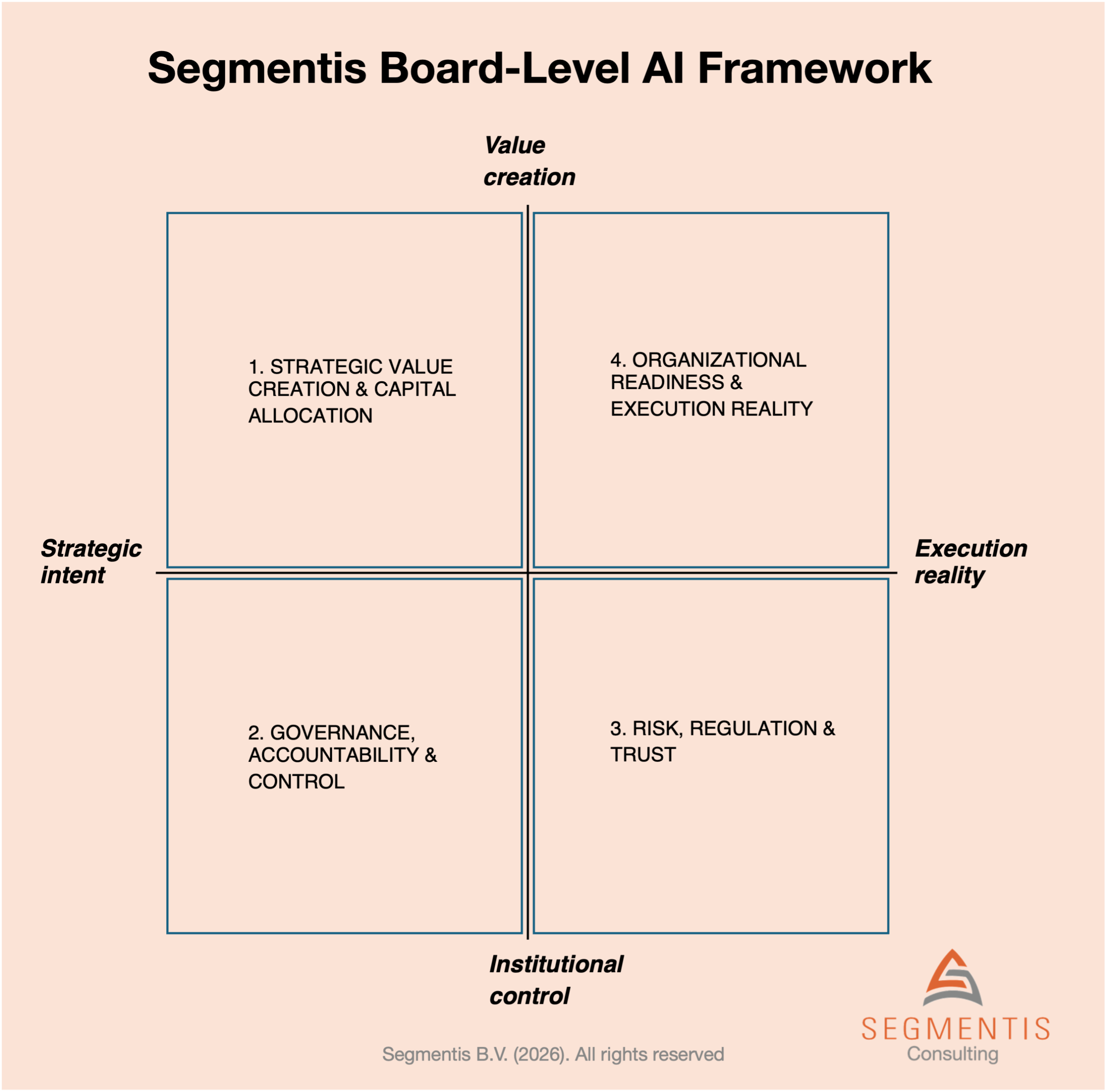
How the framework is structured
First, there is the distance between strategic intent and execution reality. Ambition is defined at the top — capital allocated, accountability assigned. But value is realized only when the organization can monitor AI outputs, manage risk, and execute with discipline.
Second, there is the tension between institutional control and value creation. Boards must ensure governance, regulatory alignment, and accountability — while enabling performance, growth, and competitive advantage.
Where these two dimensions intersect, four connected decision domains emerge:
- 1
Strategic Value & Capital Allocation
- 2
Governance, Accountability & Control
- 3
Risk, Regulation & Trust
- 4
Organizational Readiness & Execution Reality
Why this framework matters
The four dimensions are inseparable.
- Strategy without readiness becomes fantasy.
- Execution without direction becomes waste.
- Value without control becomes reckless.
- Control without value becomes stagnation.
Addressing only one or two creates imbalance.
Addressing all four creates momentum.
This is not a checklist.
Not a maturity model.
Not a compliance program.
It is a decision framework for boards that must act under uncertainty.
It helps boards:
• Make deliberate AI investment choices
• Retain accountability as AI scales
• Respond credibly to regulatory pressure
• Ensure the organization can deliver
In short, it keeps boards in control of AI — rather than reacting to it.
THE SEGMENTIS AI COMPASS FOR BOARDS
A Reader’s Guide
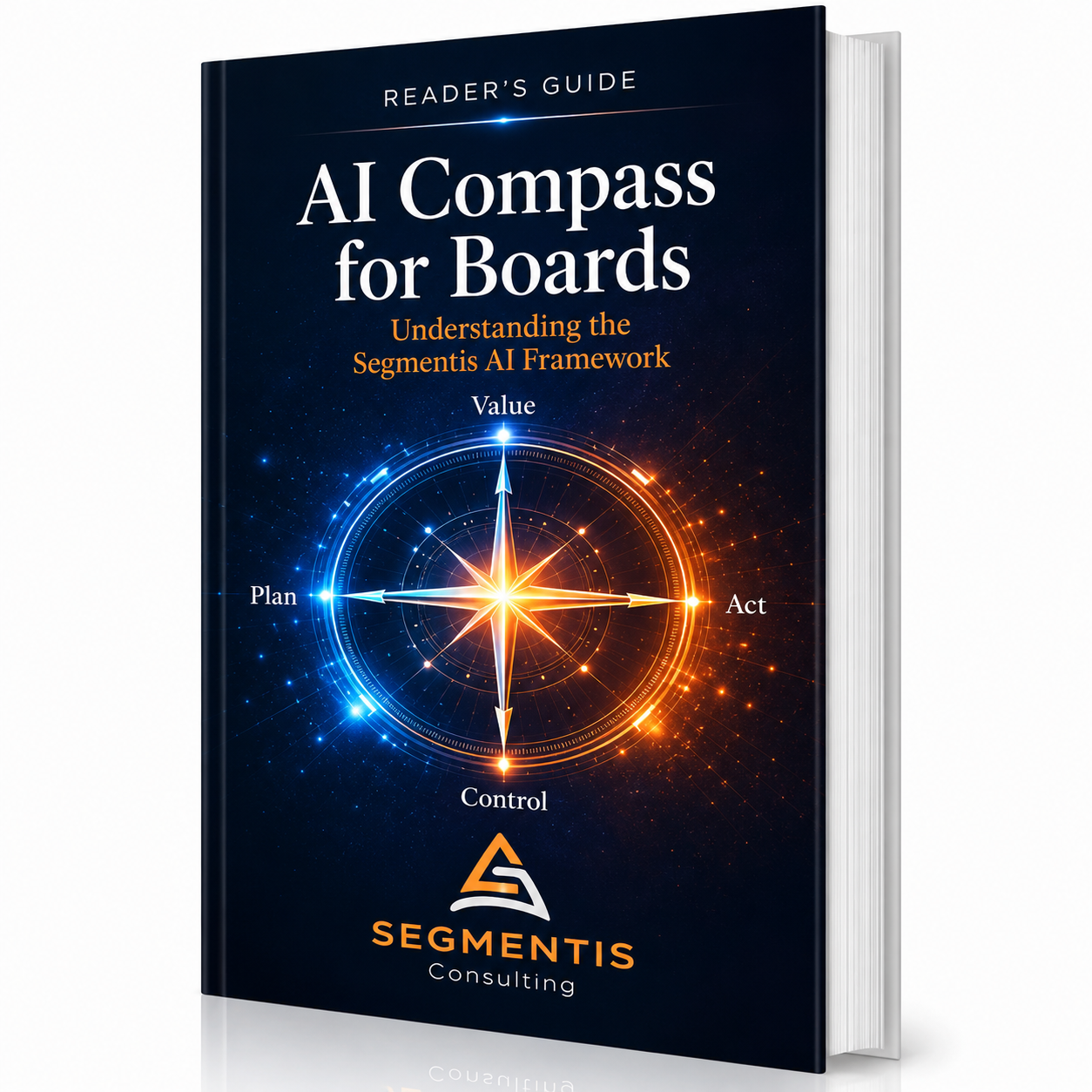
AI Compass for Boards:
Understanding the Segmentis AI Framework
The four white papers in this series explore the board’s role in creating value through AI, governing its use, managing risk, and enabling execution.
While each paper can be read independently, they are designed to form a single framework.
This Reader’s Guide introduces the framework, explains how the four dimensions fit together, and provides the context needed to get the most from the series.



From AI strategy to operational reality
In this conversation with Dux Raymond Sy of AvePoint, Segmentis founder Dr. Ori Marom discusses lessons from three decades of applying AI and automation in complex operational environments.
The discussion explores why organizations need to distinguish automation from augmentation, why AI initiatives need a clear business purpose, and why focused bets are more valuable than disconnected pilots.
Topics include: Automation versus augmentation, workforce adoption, focused bets versus pilots, digital twins, AI governance, and translating technology into business value.